Finding the planets: how to spot them and what to expect
Five planets are easy to see without any equipment once you know where and how to look. Binoculars and small telescopes then reveal moons, rings and phases.
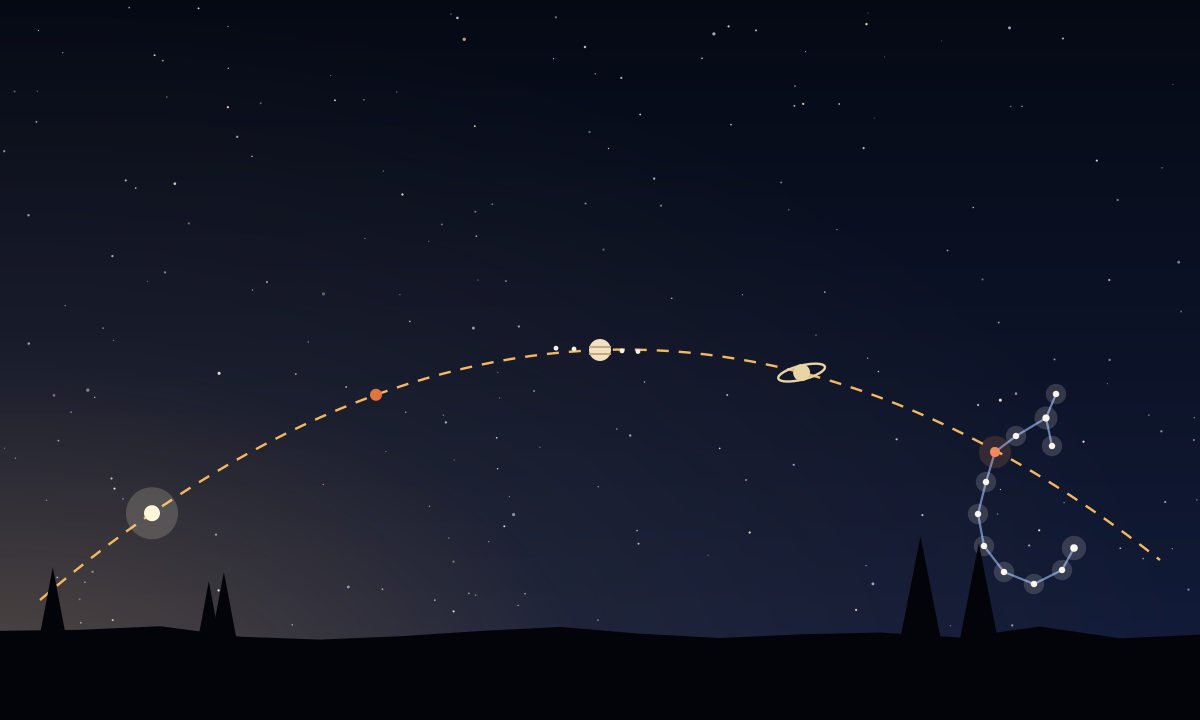
Mercury, Venus, Mars, Jupiter and Saturn have been watched since ancient times without instruments. The word planet comes from a Greek word for wanderer, because they move slowly against the background stars. That movement is also why a printed star chart cannot show their positions permanently: you need a current sky guide or a planetarium app set to tonight's date.
Where to look: the ecliptic
The planets orbit the Sun in nearly the same flat plane, so from Earth they always appear close to the ecliptic, the path the Sun traces across the sky over a year. The Moon also stays near this line. The constellations along it are the zodiac constellations, such as Taurus, Leo, Scorpius and Sagittarius. If you see a bright 'star' near the Moon, or in one of these constellations, that is not on your chart, it is very likely a planet.
How to tell a planet from a star
- Planets usually shine with a steadier light, while stars twinkle more, especially low in the sky.
- A planet is often brighter than any star around it.
- Over several nights, a planet shifts its position against the nearby stars.
- Through binoculars or a telescope a planet shows a small disc, while a star stays a point.
Planet by planet
- Venus is the brightest object in the night sky after the Moon. It never strays far from the Sun, so it appears in the west after sunset or in the east before sunrise. A small telescope shows its phases, from a small, nearly full disc to a large, thin crescent.
- Mercury stays even closer to the Sun and is only visible low in twilight for short spells each year.
- Mars looks distinctly orange-red. It is brightest around opposition, when the Earth passes between it and the Sun, which happens roughly every 26 months.
- Jupiter is bright and creamy white. Steady binoculars show up to four of its largest moons, first seen by Galileo, which change position from night to night. A small telescope adds cloud belts across the disc.
- Saturn is yellowish and fainter than Jupiter. Its rings are visible in almost any small telescope at modest magnification, a sight many people remember for life.
Sun safety with the inner planets
Sun safety. Mercury and Venus are always seen near the Sun. Never search for them with binoculars or a telescope while the Sun is above the horizon, and never sweep optics across the place where the Sun has just set until it is completely gone. Catching the Sun in the field of view, even by accident, can cause permanent eye damage instantly.
Worked example: following Jupiter's moons
When Jupiter is well placed in the evening sky, observe it at the same time on four or five nights. Brace your binoculars firmly or use a telescope at low power. Draw the planet as a small circle and mark each moon as a dot on either side. Over a few nights the pattern changes completely as the moons orbit, and on some nights one or more will be missing, hidden behind the planet or lost in its glare as it crosses in front. Similar observations by Galileo helped show that not everything in the sky circles the Earth.
Common mistakes
- Using a chart from another year; planet positions change constantly.
- Expecting large, colourful discs. Even in a good small telescope, planets look small; detail comes with patience and steady air.
- Observing planets low over rooftops, where rising warm air blurs the view. Wait for them to climb higher.
Key points
- Look along the ecliptic, near the Moon and the zodiac constellations.
- Steady light and slow movement give planets away.
- Wait until the Sun has fully set before using optics on Venus or Mercury.