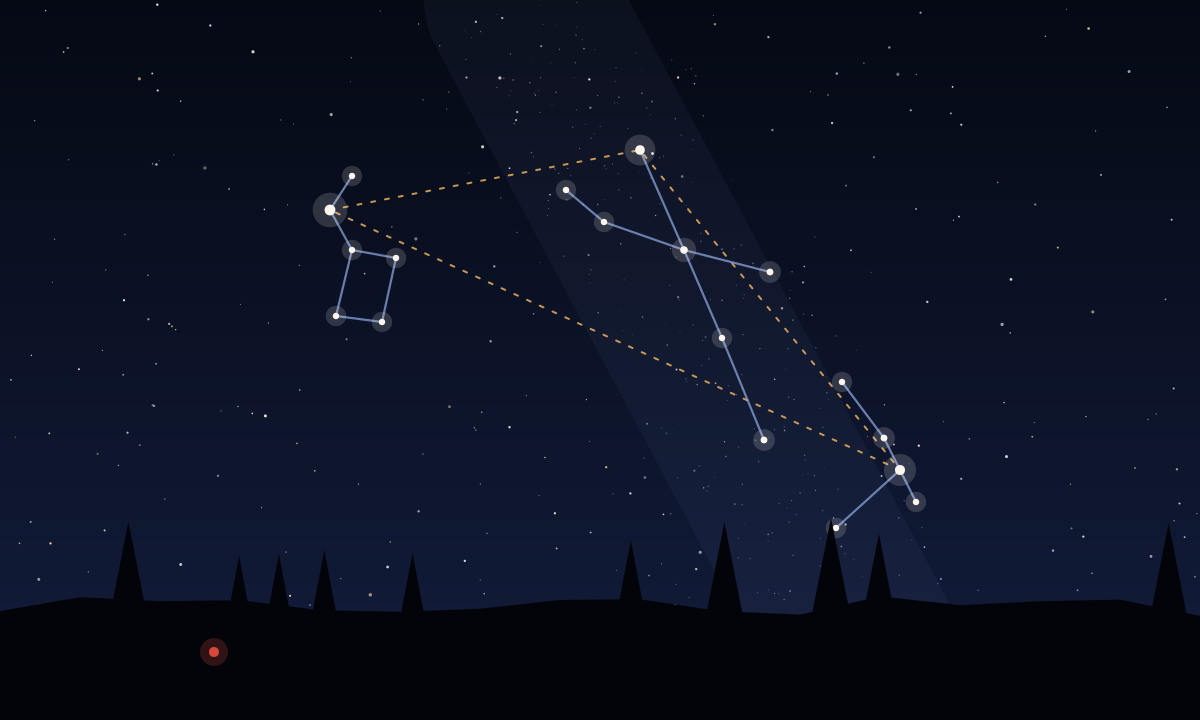
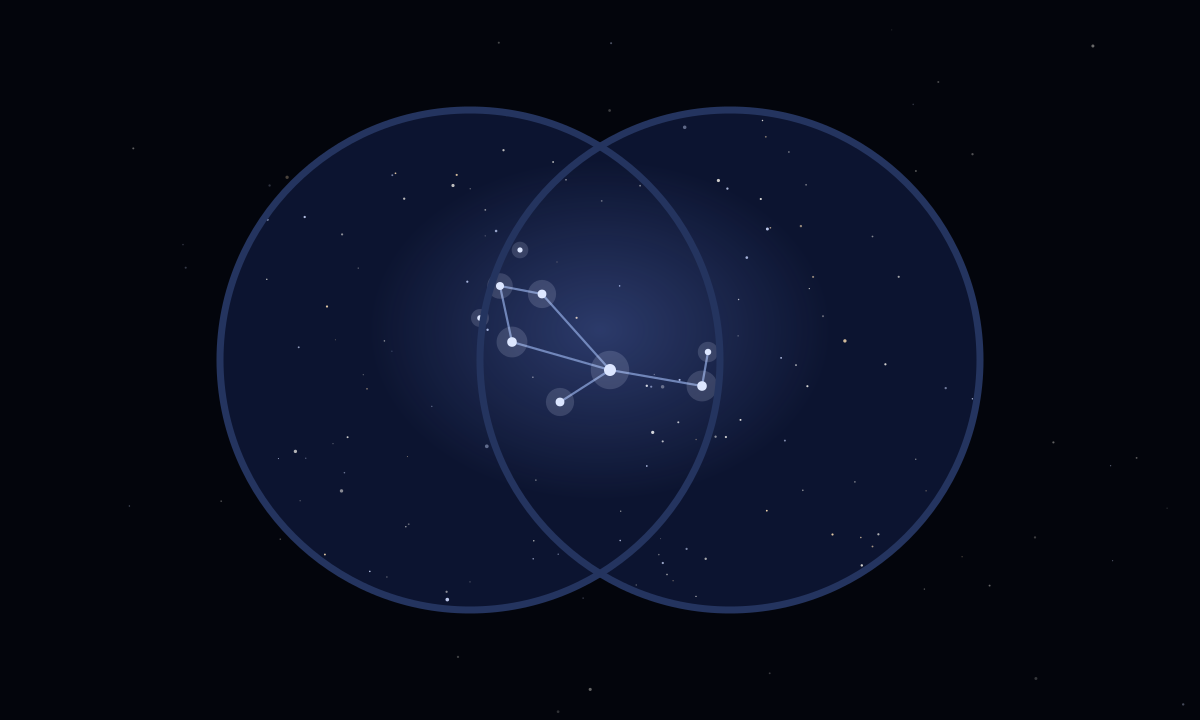
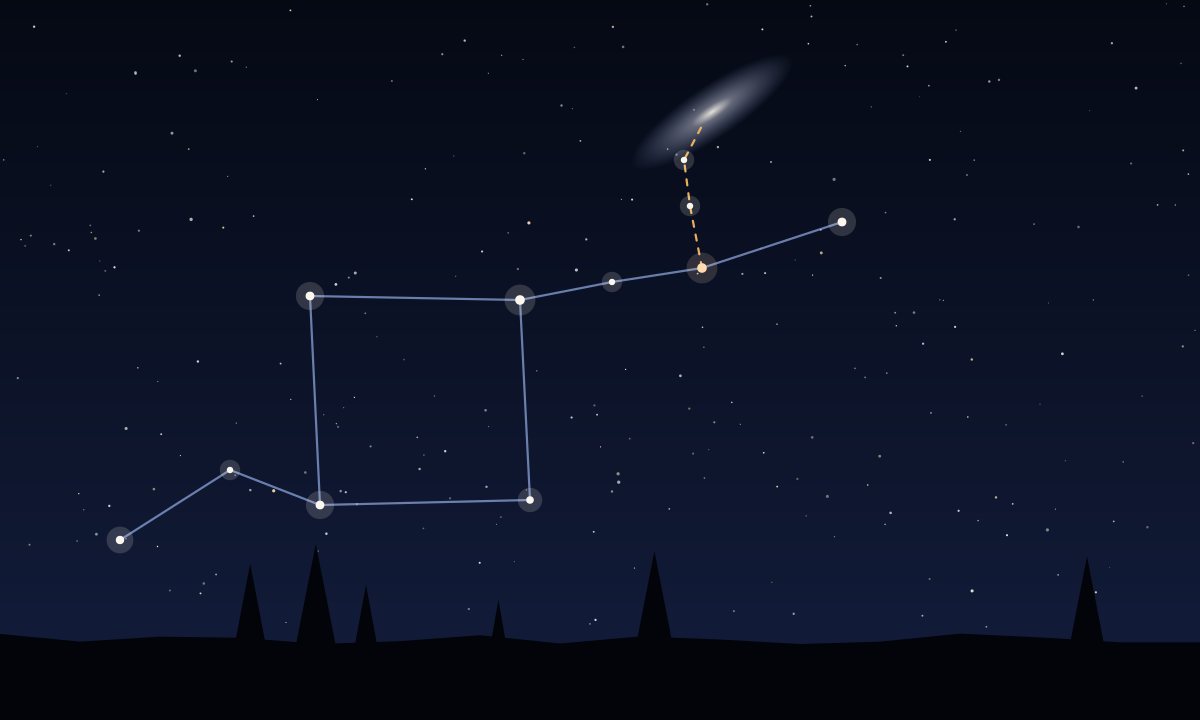
How to read a star chart and find your way around the sky
A star chart looks crowded at first, but three habits (holding it the right way up, measuring with your hand and hopping from bright stars) turn it into a dependable map.
The night sky can look like a random scatter of lights, yet it is one of the most predictable things in nature. The stars keep the same patterns for lifetimes, and the whole sky appears to turn around the celestial poles as the Earth rotates. A star chart is simply a map of those patterns, and once you can read one, most beginner targets are within reach.
Know what the chart is showing
Most beginner charts show stars as dots of different sizes, and bigger dots mean brighter stars. Astronomers measure brightness in magnitudes, and the scale runs backwards: a star of magnitude 1 is brighter than one of magnitude 3. Under a truly dark sky the faintest stars visible to the naked eye are around magnitude 6. From a town you may reach only magnitude 3 or 4, so do not worry if your sky shows fewer stars than the chart.
Charts also mark the constellations, the 88 officially recognised regions of the sky, and often asterisms, which are familiar shapes that are not official constellations. The Plough, also called the Big Dipper, is an asterism inside the larger constellation Ursa Major.
Hold it the right way up
A sky chart is designed to be held overhead, so east and west appear swapped compared with a road map. Face the direction you want to explore and turn the chart until the matching horizon label is at the bottom. A planisphere, a rotating disc chart, makes this easier: line up the date with the time and the window shows the sky for that moment. Planispheres use standard time, so if daylight saving time is in force, subtract an hour before setting the dial.
Measure the sky with your hand
Distances on the sky are given as angles, not centimetres. Your hand held at arm's length is a surprisingly good ruler. These are rough guides that work for most adults:
- Width of the little finger: about 1 degree. The full Moon is only about half a degree across.
- Three middle fingers together: about 5 degrees.
- A closed fist: about 10 degrees.
- A spread hand, thumb tip to little-finger tip: roughly 20 to 25 degrees.
Worked example: from the Plough to Polaris
For observers in the Northern Hemisphere, this is the classic first star-hop.
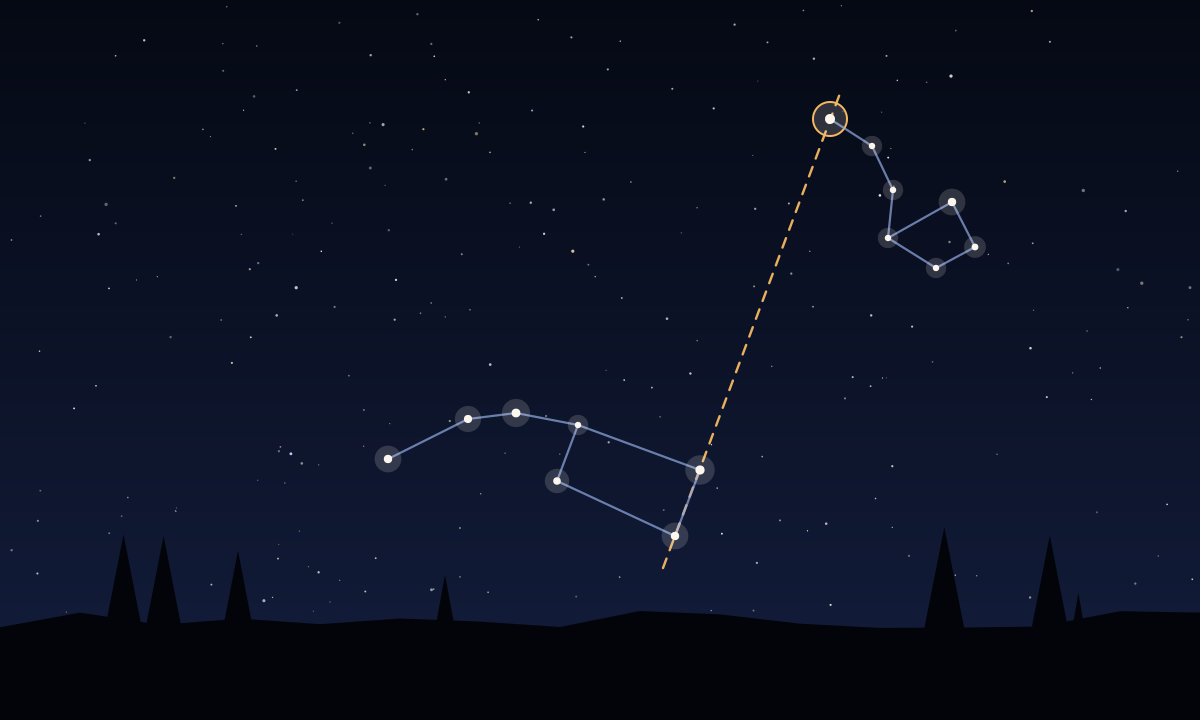
- Find the Plough. Its seven bright stars form a saucepan shape. On spring evenings it is high in the north; in autumn it sits lower, near the northern horizon.
- Locate the two stars at the end of the pan, furthest from the handle. These are Merak and Dubhe, known as the Pointers.
- Imagine a line from Merak through Dubhe and extend it about five times the gap between them.
- You arrive at a moderately bright star standing fairly alone. That is Polaris, the Pole Star. It is not the brightest star in the sky, but it barely moves while everything else circles around it.
Polaris tells you two more useful things. The point on the horizon directly below it is true north, and its height above the horizon in degrees roughly equals your latitude. Check it with your fists: at 40 degrees north it sits about four fists up.
Common mistakes
- Expecting the chart's scale to match the sky. Constellations look far larger overhead than on paper, so start with the brightest patterns.
- Using a white torch. Even a quick flash of white light spoils your night vision. Cover a torch with red film or use a dim red light.
- Forgetting the clock. The same view arrives about four minutes earlier each night, or roughly two hours earlier each month.
- Starting with faint targets. Learn a few bright guide stars first; they are your signposts.
In the Southern Hemisphere
Polaris cannot be seen from southern latitudes, and there is no bright south pole star. Instead, observers use the Southern Cross and the two bright Pointers beside it, Alpha and Beta Centauri, to estimate where the south celestial pole lies. The method is the same: start from bright, unmistakable stars and hop outwards.
Key points
- Hold the chart overhead and turn it to match the horizon you are facing.
- Measure distances with your hand at arm's length.
- Start from bright guide stars and hop outwards in small steps.