Clusters, nebulae and galaxies: your first deep-sky targets
Beyond the solar system lie star clusters, glowing clouds of gas and other galaxies. Many are within reach of binoculars once you know what they really look like.
Deep sky is the observers' name for everything beyond our solar system apart from individual stars: star clusters, nebulae and galaxies. Many of the brightest were listed in the eighteenth century by the French astronomer Charles Messier, whose catalogue, with later additions, contains 110 objects and gives them their familiar M numbers. It remains a natural starting list.
Set realistic expectations
Photographs of nebulae and galaxies are long exposures that gather light for minutes or hours. The eye cannot do that, and in dim light it sees little colour, because the cells that work best in the dark do not distinguish colours. Most deep-sky objects therefore appear as grey glows or soft patches. The reward is knowing what you are looking at: light that has travelled for thousands or millions of years to reach you.
The main kinds of object
- Open clusters: loose groups of young stars born together, such as the Pleiades in Taurus. Binoculars suit them well.
- Globular clusters: dense balls of hundreds of thousands of old stars, such as M13 in Hercules. They look like fuzzy stars in binoculars and begin to break into individual stars in larger telescopes.
- Nebulae: clouds of gas and dust. The Orion Nebula, M42, in the sword below Orion's belt, is visible to the naked eye from a dark site as a misty patch.
- Galaxies: vast systems of stars far beyond the Milky Way. They are faint and need dark skies.
Worked example: hopping to the Andromeda Galaxy
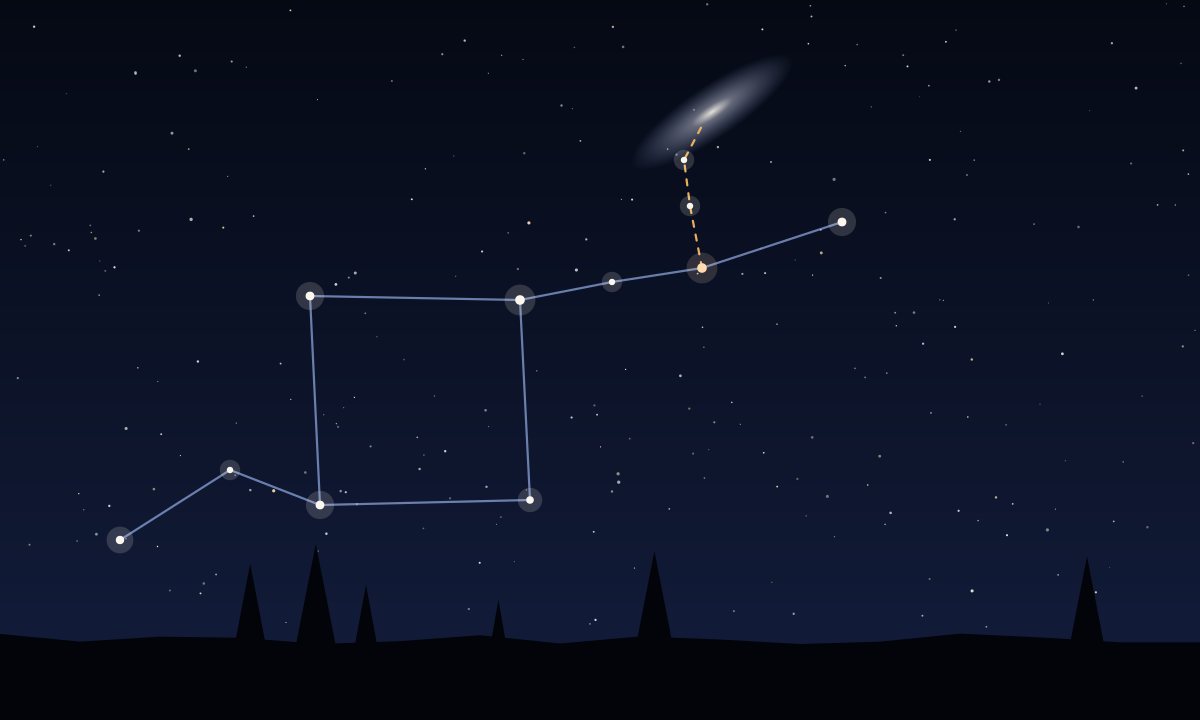
The Andromeda Galaxy, M31, is about 2.5 million light-years away and is the most distant object most people can see without optical aid. From the Northern Hemisphere it is well placed on autumn evenings.
- Find the Great Square of Pegasus, four moderately bright stars forming a large square, high in the south-eastern to southern sky.
- From the corner star Alpheratz, follow a gently curving line of two bright stars leading away from the square; the second of these is Mirach.
- From Mirach, turn roughly at right angles towards the W-shaped constellation Cassiopeia and hop through two fainter stars.
- Just beyond the second faint star, look for an elongated, misty glow. Use averted vision; in binoculars it becomes an obvious oval smudge with a brighter centre.
A seasonal starter list
These bright examples suit binoculars or a small telescope from mid-northern latitudes:
- Autumn: the Andromeda Galaxy, and the Double Cluster in Perseus, two rich open clusters side by side.
- Winter: the Pleiades and the Orion Nebula.
- Spring: the Beehive Cluster, M44, in Cancer, a large open cluster that shows as a hazy patch to the naked eye under dark skies.
- Summer: the globular cluster M13 in Hercules and the star clouds of the Milky Way towards Sagittarius.
From the Southern Hemisphere, the Large and Small Magellanic Clouds, two companion galaxies of the Milky Way, and the great globular cluster Omega Centauri are spectacular naked-eye sights.
Keep a simple log
For each object, note the date, time, instrument and sky conditions, and add a quick sketch of what you actually saw rather than what photographs show. Over a season you will notice how much your eyes improve with practice, and the log becomes your own guide to what your sky can reveal.
Common mistakes
- Hunting faint galaxies under a bright Moon. Save them for the dark nights around new Moon.
- Using high magnification. Most deep-sky objects look best at low power, where they appear brighter and fit in the field.
- Hurrying. Give each object a few minutes; details emerge slowly as your eyes work.
Key points
- Deep-sky objects look like soft grey glows, not photographs.
- Use low magnification, dark skies and averted vision.
- Star-hop from bright stars rather than sweeping at random.