Observing the Moon: phases, craters and the terminator
The Moon is the easiest target in the sky and one of the most rewarding. Knowing when to look, and where, turns a bright disc into a landscape.
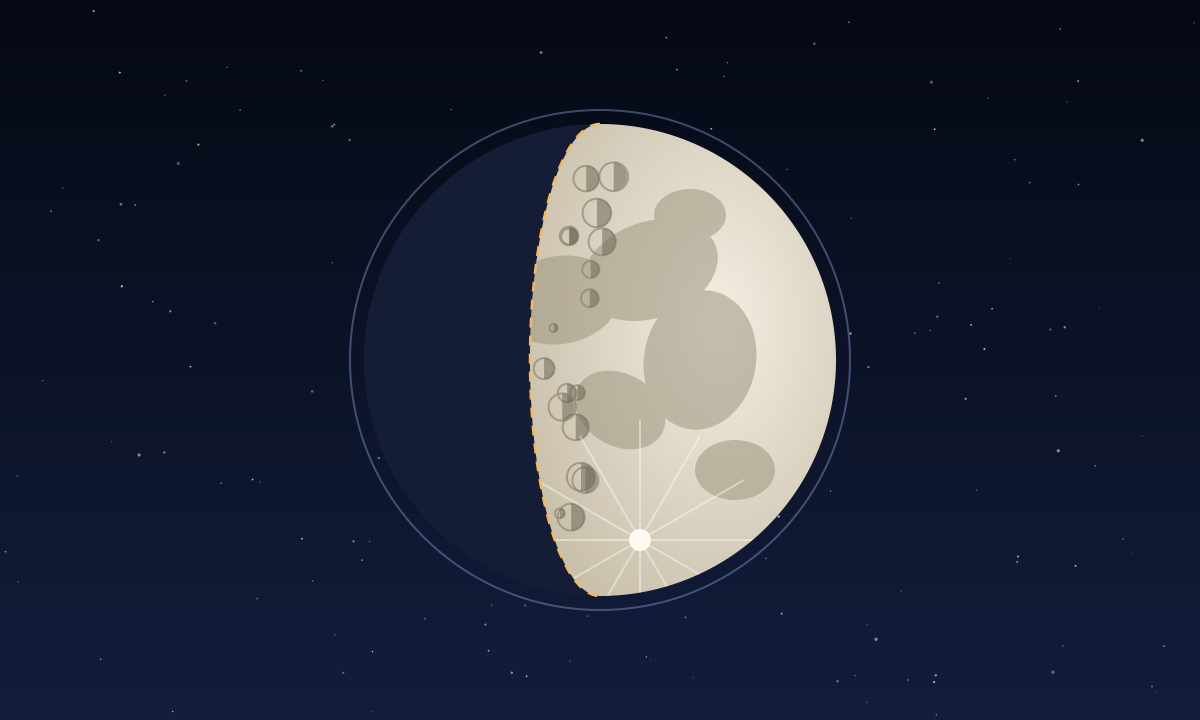
The Moon is close, bright and full of detail. It can be seen from the middle of a city, it needs no dark site, and even a small pair of binoculars shows craters. Many observers spend years exploring it and never run out of things to see.
Why the phase changes everything
The Moon goes through its cycle of phases about every 29.5 days. It always shows us essentially the same face, because it turns once on its axis for every orbit of the Earth, but the sunlit part we see changes as it moves around us.
Many beginners wait for a full Moon, yet that is usually the least interesting time to look. With sunlight falling straight onto the surface there are almost no shadows, and the view looks flat. The best views come when the Moon is a crescent, at first or last quarter, or gibbous.
Follow the terminator
The terminator is the line dividing lunar day from lunar night. Along it, the Sun is low in the lunar sky, so crater walls and mountains cast long shadows. Features that are invisible at full Moon stand out in sharp relief. Because the terminator moves a little every night, the same crater can look quite different from one evening to the next.
What to look for
- The maria, or 'seas': dark, smooth plains of ancient solidified lava, easy to see with the naked eye.
- Craters of every size, from huge walled plains to tiny pits, best near the terminator.
- Mountain ranges such as the Apennines, whose peaks catch sunlight before the ground around them.
- Bright rays around younger craters such as Tycho and Copernicus, which actually show best near full Moon.
- Earthshine: the faint glow on the dark part of a thin crescent, which is sunlight reflected from the Earth.
Worked example: a week with the Moon
Try following the Moon on several evenings after new Moon:
- Three or four days after new Moon, a thin crescent sets not long after the Sun. Look for earthshine with the naked eye or binoculars.
- Around first quarter, roughly a week after new Moon, the terminator runs down the middle of the disc. Scan along it for crater chains and mountain shadows.
- One or two nights later, the gibbous Moon brings the large crater Copernicus close to the terminator.
- Near full Moon, switch to the bright rays from Tycho, in the southern highlands, which stretch across much of the disc.
Sun safety. A young crescent Moon is often close to the Sun in the sky. Wait until the Sun has fully set before raising binoculars or a telescope. If you look at the Moon in daylight, make sure the Sun is far from your field of view and hidden behind a building or tree.
Comfort at the eyepiece
Through a telescope a bright Moon can be dazzling. That is uncomfortable rather than harmful, and there are simple fixes: raise the magnification so less of the bright surface fills the view, observe away from full Moon, or use a neutral-density Moon filter that screws into the eyepiece. A Moon filter is not a solar filter and must never be used to look at the Sun. Keeping a little light around you also reduces the glare.
Common mistakes
- Only observing at full Moon.
- Using too much magnification on an unsteady night; a sharp, smaller image beats a large, blurry one.
- Forgetting that the Moon rises about 50 minutes later each night on average, so it may not be where you expect.
Key points
- Observe around first and last quarter, not only at full Moon.
- Scan along the terminator, where shadows are longest.
- Wait for the Sun to set before using optics on a crescent Moon.